
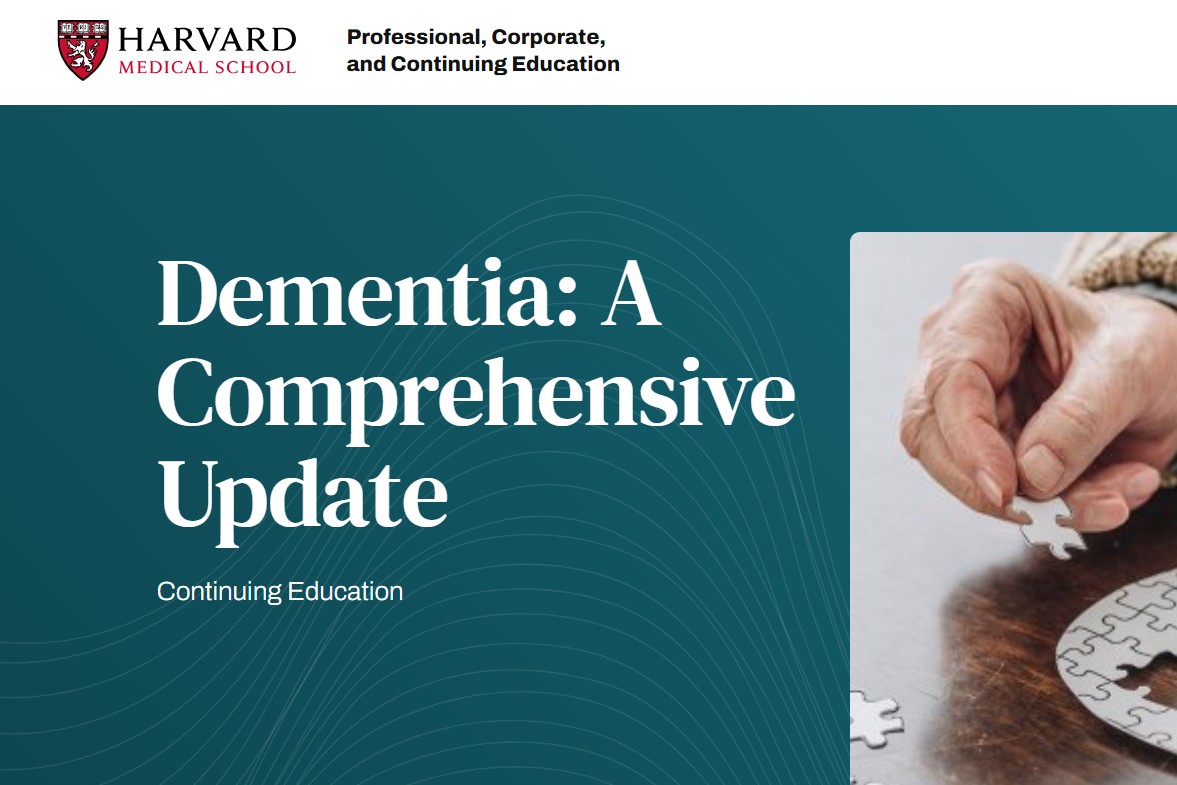
2026 Course Overview
Videos+PDFS
Full Syllabus and Samples : Click Here
Dementia: A Comprehensive Update (Harvard CME)
🧠 Dementia: A Comprehensive Update – Advancing Knowledge in Cognitive and Behavioral Neurology
The spectrum of neurodegenerative diseases ranges from asymptomatic preclinical stages and mild cognitive impairment (MCI) to advanced dementia. As the leading cause of dementia worldwide, Alzheimer’s disease (AD) continues to pose profound clinical, emotional, and societal challenges for patients, families, and healthcare systems.
Now in its 29th year, Dementia: A Comprehensive Update is a premier three-and-a-half-day educational program designed by clinicians for clinicians. Led by expert faculty from Harvard Medical School and affiliated institutions, including Brigham and Women’s Hospital, Massachusetts General Hospital, Beth Israel Deaconess Medical Center, McLean Hospital, and Banner Sun Health Research Institute/Banner Health, this course provides a practical, multidisciplinary, and evidence-based approach to dementia care.
The program brings together nationally and internationally recognized experts to explore:
🔹 The latest advances in Alzheimer’s disease, vascular cognitive impairment, Lewy body dementia, frontotemporal degeneration, Parkinsonian dementias, and other neurodegenerative disorders
🔹 New Alzheimer’s Association Clinical Practice Guidelines for the evaluation of cognitive impairment
🔹 Emerging biomarkers, including CSF amyloid/tau analysis, MRI, FDG-PET, and amyloid/tau PET imaging
🔹 Recently approved disease-modifying therapies for Alzheimer’s disease and future therapeutic strategies
🔹 Practical office-based cognitive assessments, neuropsychological testing, and diagnostic decision-making
🔹 Management of behavioral and neuropsychiatric symptoms through pharmacological and non-pharmacological approaches
🔹 Caregiver support, psychosocial interventions, quality-of-life considerations, and community resources
🔹 Ethical, legal, and safety issues, including capacity assessment, driving, financial decision-making, undue influence, and advance care planning
🔹 Delirium, chronic traumatic encephalopathy (CTE), palliative care, hospice care, and end-of-life considerations
Key Learning Outcomes
Participants will gain the knowledge and skills to:
✅ Differentiate normal cognitive aging, MCI, Alzheimer’s disease, and other dementias
✅ Apply evidence-based diagnostic and management strategies using cognitive testing, laboratory studies, neuroimaging, and biomarkers
✅ Distinguish AD from Dementia with Lewy Bodies (DLB), Frontotemporal Dementia (FTD), Vascular Cognitive Impairment (VCI), Parkinson’s Disease Dementia (PDD), and related disorders
✅ Integrate pharmacologic and non-pharmacologic interventions into individualized care plans
✅ Recognize and manage neuropsychiatric symptoms, behavioral challenges, and caregiver burden
✅ Address medico-legal, ethical, and safety concerns affecting patients and families
✅ Understand the neural networks underlying memory, language, executive function, visuospatial processing, and motor systems
✅ Identify preclinical AD, prodromal AD/MCI due to AD, and dementia-stage disease
✅ Recognize delirium, encephalopathy, and CTE as important contributors to cognitive impairment and dementia risk
This comprehensive course equips healthcare professionals with the latest knowledge, practical tools, and interdisciplinary perspectives needed to improve the diagnosis, treatment, and care of individuals living with cognitive disorders and dementia.
Dementia: A Comprehensive Update 2026
May 27–30, 2026
Join leading experts in cognitive neurology, geriatrics, psychiatry, neuropsychology, and dementia research for four days of cutting-edge education covering the full spectrum of cognitive aging, mild cognitive impairment (MCI), Alzheimer’s disease (AD), and related dementias.
Day 1: Foundations, Alzheimer’s Disease & Emerging Biomarkers
Wednesday, May 27, 2026
The course begins with an exploration of the neural and cognitive foundations underlying human cognition and memory, followed by updates on Alzheimer’s disease neuropathology, neuroimaging, and biomarkers.
Featured Topics
- Human Cognition: An Overview
- Memory Systems and Amnesia
- Neuropathology of Alzheimer’s Disease and Related Dementias
- Neuroimaging and Biomarkers in Clinical Practice
- Global Perspectives on Alzheimer’s Disease
- Clinical Use of Blood Biomarkers in 2026 and Beyond
- Practical Evaluation and Management of Alzheimer’s Disease
- Mild Cognitive Impairment: Prodromal AD and Beyond
- Advances in Alzheimer’s Disease Experimental Therapeutics
Distinguished Faculty
Brad Dickerson, Andrew Budson, Matthew Frosch, David Wolk, Maria Carrillo, Suzanne Schindler, Ronald Petersen, Alireza Atri
Day 2: Differential Diagnosis, Cognitive Assessment & Disease-Modifying Therapies
Thursday, May 28, 2026
Focused on recognizing and differentiating dementia syndromes through neuropsychology, clinical assessment, and emerging treatment strategies.
Featured Topics
- Neuropsychology of Aging
- Attention and Executive Function
- Frontotemporal Dementia (Behavioral and Executive Variants)
- Language Disorders and Aphasia-Predominant Dementias
- Vascular Cognitive Impairment and Dementia
- Lewy Body Disease and Parkinsonian Dementias
- Cognitive Assessment in Clinical Practice
- Practical Compensatory Strategies for Cognitive Decline
- Assessment of Daily Function, Neuropsychiatric Symptoms and Dementia Staging
- Case-Based Discussion of Lecanemab and Donanemab
Distinguished Faculty
Sandra Weintraub, Kirk Daffner, Bruce Miller, Marsel Mesulam, Charles DeCarli, James Galvin, Lynn Shaughnessy, David Wolk, Alireza Atri, Brad Dickerson
Day 3: Behavioral Symptoms, Caregiving, Ethics & Special Topics
Friday, May 29, 2026
A comprehensive review of behavioral and psychological symptoms of dementia, caregiver support, ethical decision-making, and uncommon dementias.
Featured Topics
- Non-Pharmacological Management of Behavioral Symptoms
- Pharmacological Approaches to Neuropsychiatric Symptoms
- Ethical Considerations in Disclosure of Dementia Diagnosis and Risk
- Caregiving in Dementia: Challenges and Opportunities
- Community Advocacy and Activism
- Chronic Traumatic Encephalopathy (CTE)
- Delirium, Encephalopathies and Uncommon Dementias
Distinguished Faculty
Helen Kales, Clive Ballard, Jason Karlawish, Mary Mittelman, Katie Brandt, Robert Stern, Jeremy Schmahmann
Day 4: Legal, Safety & End-of-Life Considerations
Saturday, May 30, 2026
The final day focuses on the practical legal, ethical, and safety challenges encountered throughout the dementia care continuum.
Featured Topics
- Testamentary Capacity and Undue Influence
- Mental Capacity and Competence in Dementia
- Financial, Legal and Safety Decision-Making
- Driving, Home and Community Safety
- Advance Care Planning
- Management of End-Stage Dementia
- Pain Management, Palliation and Hospice Care
Distinguished Faculty
Judith Edersheim, Bruce Price, Barry Fogel, Margaret O’Connor, Mary Norman
Key Learning Themes Throughout the Course
✅ Advances in Alzheimer’s disease diagnosis and treatment
✅ Blood, CSF and imaging biomarkers
✅ Mild Cognitive Impairment and preclinical Alzheimer’s disease
✅ Frontotemporal, vascular, Lewy body and Parkinsonian dementias
✅ Cognitive assessment and neuropsychological testing
✅ Disease-modifying therapies including Lecanemab and Donanemab
✅ Behavioral and neuropsychiatric symptom management
✅ Caregiver support and quality-of-life interventions
✅ Ethical, legal and safety considerations
✅ Delirium, CTE and uncommon dementia syndromes
✅ End-of-life care, palliation and hospice
This intensive four-day program provides clinicians with the latest evidence, practical tools, and multidisciplinary perspectives necessary for the diagnosis, treatment, and comprehensive management of patients across the spectrum of cognitive impairment and dementia.